
By Dr. Margaret D. Kottke, MD (Dermatology) · Medically reviewed by Dr. Samantha Brown-Parks, MD (Family Medicine)
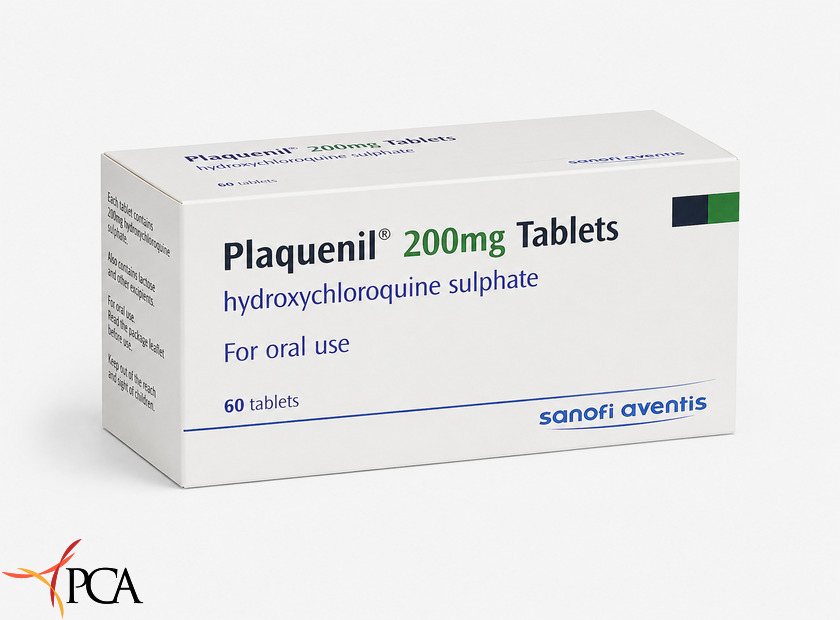
Buy Plaquenil (Hydroxychloroquine) online, the tablet that quiets an overactive immune system without shutting any part of your defenses down. Lupus and rheumatoid arthritis are where it earns its place. Nothing about it is fast, and that is a feature of the chemistry rather than a flaw. Two things decide how well it goes. The daily amount is one, and a retinal check most people underestimate is the other.
What Hydroxychloroquine Does Inside a Cell
Hydroxychloroquine does not destroy immune cells. It changes the chemistry of a small compartment inside them and lets that shift do the work. The molecule is a weak base. It drifts into acidic pockets called lysosomes and raises the pH there. Many people who buy plaquenil online expect something that switches immunity off. This mechanism is far quieter than that.
Two consequences follow from that pH shift. Lysosomes are where a cell chops up proteins and displays the fragments to passing T cells. Raise the pH and that chopping slows, so fewer self-fragments get presented. The autoimmune conversation loses volume rather than being cut off.
The second effect happens on sensors buried inside the same compartments. Toll-like receptors sit there and react to loose DNA and RNA. In lupus that material comes from a person’s own dying cells. Hydroxychloroquine blocks that recognition. Interferon output falls as a result. That signal drives much of lupus activity.
The LiverTox monograph classes it among antirheumatic agents and describes the same lysosomal action. The membranes themselves are steadied as well. Fewer inflammatory enzymes escape into the surrounding tissue. It is a 4-aminoquinoline, the same chemical family used against malaria, which is where its antimalarial label comes from.
- •No cell counts drop — white cells and lymphocytes stay where they were.
- •Tissue storage — it builds up in skin, liver, and retina far above blood levels.
- •A half-life of weeks — one tablet is still leaving the body a month later.
That last trait shapes everything downstream. A medication clearing over forty days needs months of daily tablets before tissue levels plateau. The same slowness works in reverse, so a few missed days barely register. Both the delayed benefit and the delayed risk trace back to that one number.
Lupus and Arthritis Flares Plaquenil Calms
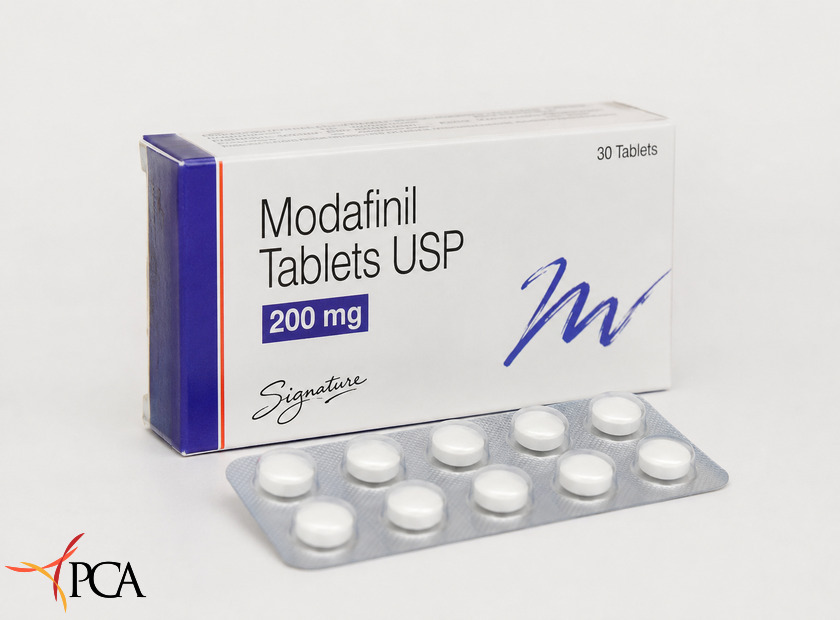
Systemic lupus is the main indication. Nearly every patient with it takes hydroxychloroquine unless something specific rules that out. Cutaneous and discoid lupus respond as well, often visibly. Rheumatoid arthritis is the third pillar, usually in milder disease or alongside other treatments. Autoimmune fatigue runs through all of these and answers poorly to any of them, which is why a wakefulness medication is sometimes trialled separately. Sjögren’s syndrome rounds out the everyday list.
Systemic lupus
Fewer flares, less organ damage over time, and a lower clotting risk.
Skin lupus
Discoid plaques and photosensitive rashes that flatten over months.
Rheumatoid arthritis
Morning stiffness and joint swelling in milder or combined regimens.
Sjögren’s
Joint pain and fatigue more than the dryness itself.
The lupus evidence goes further than symptom relief. Patients who stay on it accumulate less kidney and organ damage across decades. Flare frequency drops. The NIAMS lists antimalarials among the treatments used across the full range of lupus severity. Mild disease is not the limit.
Pregnancy is one place where it is continued rather than paused. Stopping tends to provoke a flare at the worst possible moment. In women carrying certain lupus antibodies it does more. The chance of a specific heart rhythm problem in the baby drops.
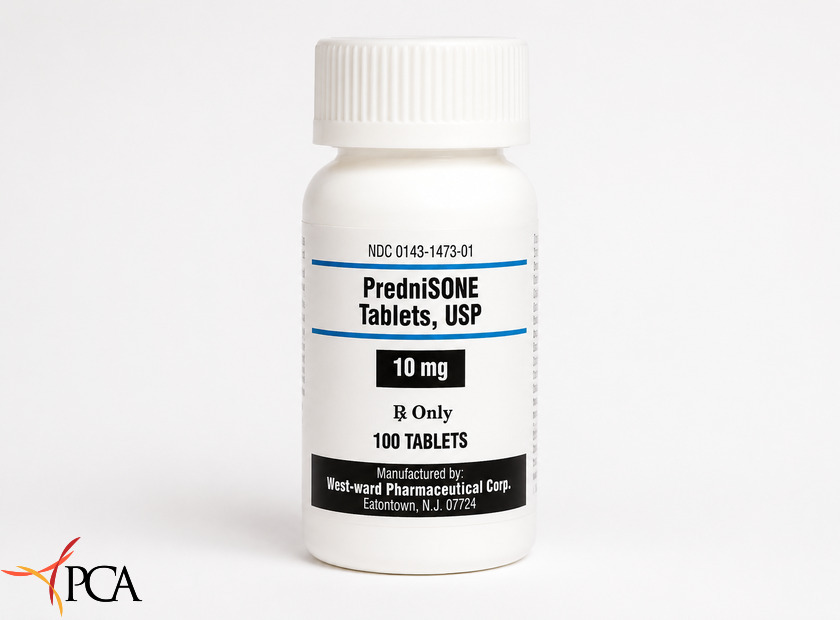
What it will not do is act as a painkiller. Nothing happens within an hour of a tablet. A bad joint day does not respond to an extra one. Its effect is measured across months of steady tissue levels. Rapid relief during a flare comes from a different part of the plan. That is usually a short course of prednisone, tapered once the tablet regains control.
Malaria stays on the label, though it is rarely the reason for a prescription here now. Travelers to certain regions take it as prevention on a weekly schedule. That course is short and unrelated to the daily one. Patients who buy plaquenil online for lupus are on a completely different footing.
Immunomodulator Rather Than Immunosuppressant
Hydroxychloroquine adjusts immune signaling without removing immune cells. Rheumatologists call it an immunomodulator for that reason. A true immunosuppressant lowers your defenses against ordinary infection. This one does not, and the distinction has practical weight for anyone who decides to buy plaquenil online.
The differences show up in monitoring. Medications that suppress the marrow require regular blood counts to catch a falling white cell line. Hydroxychloroquine does not deplete those cells, so that particular schedule of tests is unnecessary. Liver and kidney checks still happen for other reasons.
Vaccines behave normally too. Live vaccines are restricted for people on genuine immunosuppression. Hydroxychloroquine alone does not place you in that group. Patients often take it alongside something stronger, and the restriction then comes from the other medication.
It is also not a steroid
Steroids act within days. They bring weight gain, thinning bone, and rising blood sugar with them. Hydroxychloroquine shares none of that. Its whole purpose in many treatment plans is to let the steroid dose come down.
That steroid-sparing role explains its position in most regimens. A flare gets controlled quickly with prednisone, and hydroxychloroquine holds the ground once the steroid tapers. One works in days and leaves side effects behind. The other works in months and mostly does not.
Where to Buy Plaquenil Online Safely
A licensed United States pharmacy is the sound place to buy plaquenil online. It asks for a prescription first. Searches for buy plaquenil without prescription lead somewhere else entirely. That route carries a risk specific to this medication rather than a general one.
Here is why it matters more here than with a short antibiotic course. Hydroxychloroquine produces nothing you can feel for months. An underdosed tablet would feel exactly like a genuine one. That holds through the entire period when you might have noticed. The first real signal could be a flare a year later.
Two public tools settle the question. The NABP maintains Safe.Pharmacy, which shows whether a site meets real standards. The FDA runs BeSafeRx alongside it. Both name the sellers already known to be trouble.
Holding a prescription from your rheumatologist already? You can send it through our prescription upload page and a licensed pharmacy takes it from there. Refills matter more than the first fill with a medication taken for years. A gap of several weeks lets tissue levels slide, and rebuilding them takes months.
Continuity is the practical draw. An autoimmune condition means the same tablet every day for an indefinite stretch. The pharmacy step should be the least demanding part. The reason to buy plaquenil online is usually to keep a long refill chain from breaking.
Order Plaquenil Online in Three Steps
The sequence mirrors a clinic visit with the review moved onto a screen. Your diagnosis, your weight, and your eye screening history all enter into it.
Share your diagnosis, your current weight, and when your eyes were last screened.
A physician checks the daily amount against your weight and kidney results.
The supply ships with a refill schedule built around a continuous course.
Your file stays with the care team between refills. Weight changes and new kidney results both alter the target amount. Neither shows up unless someone is watching.
What Plaquenil Costs Per Tablet
The plaquenil cost per tablet falls sharply as the supply grows. The 200 mg strength carries the lower figure by a wide margin. Most adults take one or two tablets of that strength daily, so a ninety-count covers a full quarter. Anyone comparing a plaquenil 200mg price against the 400 mg tablet sees the same pattern. The smaller strength is cheaper per milligram.
Annual arithmetic tells you more than a single pack does. At one 200 mg tablet a day the quarterly figure repeats four times a year. That total is what to hold against an insurance copay. Anyone who will buy plaquenil online for years compares at that scale instead.
- •Confirm the strength before ordering, since 200 mg and 400 mg are not interchangeable by count.
- •Time the refill to arrive before the current pack empties rather than after.
- •Note the generic manufacturer on the label so a switch is visible at the next fill.
The plaquenil price also moves with who made the tablet. Several manufacturers produce hydroxychloroquine sulfate, and pharmacies buy from whichever supplier is cheapest that quarter. Tablet shape and color can change between fills for that reason alone. The amount of active ingredient does not.
Two smaller figures move the total beyond pack size. Shipping is folded into some listed prices and added at checkout by others. Manufacturer changes shift the base price by a few dollars each quarter. Neither shifts much for anyone set up to buy plaquenil online quarterly.
Physicians Who Review Your Plaquenil Request
Three numbers decide the review here. Your diagnosis, your body weight, and the date of your last retinal screening. Our providers work through all three before a supply is approved.


Phone: (404) 351-7900 · Online visit: Start a telehealth visit
Pairing a dermatologist with a family physician covers the two visible ends of this medication. Skin lupus is where the benefit often shows first. It is also where pigment changes appear after years. Long-range monitoring is the other half of the job.
Weight is the detail most often left stale on a file. A daily amount set at one weight becomes too high after fifteen pounds are lost. The retinal risk moves with it. Kidney results carry similar weight, since reduced clearance pushes tissue levels up. Those two figures get revisited each time someone renews a supply through us.
Weight-Based Dosing and the 5 mg Rule
The daily amount should stay at or below 5 mg for every kilogram of your actual body weight. Actual weight, not an ideal figure from a chart. For most adults that lands between 200 and 400 mg a day, taken as one or two tablets.
The threshold comes from retinal data rather than from how well the medication works. A cohort study in Annals of Internal Medicine followed 3,325 patients on hydroxychloroquine. All had taken it at least five years with regular screening. Retinopathy had appeared in 2.7 percent at fifteen years. That group stayed at or under 5 mg per kilogram. Above 6 mg per kilogram the figure reached 21.6 percent. The published cohort shows a clean dose-response line between those points.
The ceiling is not a target. Nothing is gained by climbing toward it. The 400 mg maximum applies regardless of how heavy someone is. Tablets cannot be split reliably, so intermediate amounts are reached by alternating strengths across the week instead.
Kidney function shifts the calculation independently. Hydroxychloroquine leaves partly through the kidneys. Reduced clearance raises tissue levels at any given daily amount. Chronic kidney disease is one of the recognized risk factors for retinal change. Prescribers lower the amount rather than the frequency in that situation.
Why Many People Take Plaquenil at Night
Nausea is the reason, and it is the most frequent early complaint by a distance. Taking the tablet with dinner or at bedtime means the peak passes while you sleep. Nothing in the pharmacology requires an evening dose, so it is purely a comfort choice.
Food helps on its own terms. An empty stomach makes the queasiness sharper, and a full meal blunts it noticeably. The absorbed amount barely changes either way, which is unusual and useful here.
Those on 400 mg have a second option. Splitting into 200 mg morning and evening lowers each peak. That often settles the stomach faster than moving everything to night. The stomach effects usually fade within four to six weeks regardless of the pattern chosen.
Plaquenil Is Long-Haul Therapy Not a Quick Fix
Expect two to three months before anything shifts, and up to six for the full effect. Skin lupus sometimes moves faster, joint symptoms slower. The delay is not the condition resisting treatment. It is tissue levels climbing toward a plateau that takes that long to reach.
A substance clearing over roughly forty days needs about five of those cycles to level off. Steady state lands near the six-month mark. Nothing about swallowing more tablets shortens that curve. Loading doses have been tried and abandoned for this reason.
Early discontinuation is the most common way the treatment fails. Patients feel no change through month two, conclude it is inert, and let the prescription lapse. Adherence studies in lupus repeatedly find that a large share of people are not taking it as written. The tablet gets blamed for a trial that never actually ran.
Once it works, the course typically runs for years. Remission is not a reason to come off, since the flare protection depends on continued levels. Many patients with lupus stay on it for decades. That is exactly why the daily amount has to be right from the start.
Life events interrupt the routine more often than side effects do. Surgery, a hospital stay, or a pregnancy each raise the question of pausing. The answer is usually no. Tissue levels take months to rebuild once they slide, and that arithmetic is what keeps the tablet going through most disruptions.
The Eye Exam Plaquenil Patients Cannot Skip
A baseline retinal exam belongs in the first year, and annual screening starts after five years of use. Ophthalmologists follow the American Academy of Ophthalmology schedule for this. The reason it cannot wait for symptoms is that early damage produces none at all.
Retinal change from hydroxychloroquine begins in a ring outside the very center of vision. Reading stays sharp and colors look normal while it develops. A patient who notices a blur is already past the reversible stage. Screening exists to find it before that point.
Some people carry more risk than others. A daily amount above 5 mg per kilogram is the strongest factor, followed by duration past five years. Reduced kidney function raises it further, as does tamoxifen taken alongside, and any pre-existing disease of the macula. The StatPearls entry on chloroquine and hydroxychloroquine toxicity sets out the screening battery used to track it.
Perspective matters alongside the warning. At a correct daily amount the ten-year figure sits near 2.5 percent. Most detected cases are mild and caught before vision changes. The screening schedule is what keeps that number where it is.
Finding something early changes the plan rather than ending it. A rheumatologist and an ophthalmologist decide together whether to lower the amount or stop. Mild changes caught at that stage usually stay mild. The retina does not repair itself, so the aim is holding the line where it already sits.
How OCT Scans Catch Retinal Damage Early
Spectral domain OCT photographs the retina in cross section and shows its individual layers. Hydroxychloroquine thins one specific outer layer before anything else happens. That thinning is visible on a scan while vision is still perfect. Catching it there is the whole point.
A visual field test runs alongside the scan. The 10-2 pattern maps the central ten degrees and picks up the earliest sensitivity dips. Patients of Asian descent are screened with a wider 24-2 field instead. Damage in that group often starts further out, where the narrow test would miss it.
The bull’s-eye pattern that appears in textbooks is a late finding. A ring of pigment loss around the macula means the process has run for a long time. Modern screening aims to act years before that image could form, and a scan takes only a few minutes.
Side Effects That Fade and Ones That Do Not
Stomach upset, headache, and mild dizziness make up most of what appears early. Nearly all of it settles within six weeks. Two effects behave differently. Skin pigmentation and retinal change build slowly over years and do not reverse on their own.
The pigmentation is worth describing properly, since patients rarely expect it. A slate or blue-grey discoloration can appear after years of use. The shins, the face, and the hard palate are the usual sites. It is harmless and often patchy. Dermatologists recognize it immediately, and it can be mistaken for bruising by anyone who has not seen it before.
Two rare reactions sit further down the list. Hydroxychloroquine can affect heart muscle after very long exposure. It shows up as breathlessness or swelling rather than pain. It can also weaken proximal muscles, making stairs and rising from a chair harder. Both are uncommon and both are reversible when caught early.
Hair changes take a different form than people assume. Thinning happens but is mild, and lightening of hair color is reported more often than loss. Lupus itself causes hair shedding, which makes the two difficult to separate without a timeline.
One interaction gets missed more than the others. Antacids and supplements carrying magnesium or aluminium bind hydroxychloroquine in the gut and cut how much is absorbed. Four hours of separation removes the problem. Little else in a typical lupus regimen interferes to that degree.
Plaquenil Questions Patients Ask Most
The questions below come up repeatedly once a course is underway. Each has a short answer that does not appear on the packaging.
Can Plaquenil affect your teeth?
Not the enamel itself. Two indirect things happen instead. A slate-coloured patch can develop on the hard palate after years of use. It is the same pigment change seen on shins, alarming to look at and harmless. Dry mouth is the other, and it usually traces back to Sjögren’s rather than the tablet. Less saliva means more decay, so dental visits get scheduled closer together.
Does Plaquenil cause weight gain?
No. It has no effect on appetite, fluid balance, or metabolism. Studies in lupus patients find weight neutral or slightly improved. The confusion comes from prednisone, which is frequently taken at the same time and does drive weight up. Some people gain a little once joint pain eases and they eat normally again. That is recovery rather than a side effect.
Does Plaquenil cause hair loss?
Rarely, and usually less than the disease does. Hydroxychloroquine is prescribed to treat the scarring hair loss of discoid lupus. For many people it protects hair rather than costs it. Colour lightening is the more common report, particularly in dark or red hair. Shedding that starts months into treatment more often reflects lupus activity or low iron.
Is Plaquenil a steroid?
No, and the two work on opposite timescales. Steroids act within days by broadly damping inflammation. Bone loss and blood sugar changes come with them. Hydroxychloroquine is an antimalarial repurposed as an antirheumatic, working over months on immune signaling. Its role in most plans is to make a lower steroid dose possible.
Why does sunlight feel harsher on it?
Two things overlap here. Lupus itself makes skin react to ultraviolet light. A rash after an hour outdoors is often the condition rather than the tablet. Hydroxychloroquine treats that photosensitivity, though it can add a mild sensitivity of its own. Daily sunscreen is standard for anyone with lupus regardless of which is responsible.
Is it continued during pregnancy?
Usually yes, and that is a deliberate choice rather than an oversight. Withdrawal during pregnancy raises the flare rate at a point when a flare is most damaging. In women carrying anti-Ro antibodies it also reduces the risk of congenital heart block in the baby. Breastfeeding is generally compatible as well.
One pattern runs through all of these. Lupus and its treatment produce overlapping effects, and separating them takes a timeline rather than a symptom list. That is the value of noting when something started relative to the first tablet.
About The Author

Physician credentials verified against the NPI registry, with spoken languages confirmed across US News, WebMD, and Vitals. Pricing reflects rates observed at time of publication.
This information is provided for general educational purposes only and does not constitute medical advice. Always consult a licensed healthcare provider before starting any treatment.
Medical Disclaimer
No page can weigh you, read your kidney results, or look at the scan from your last retinal appointment. Those three inputs set the daily amount and the screening interval for hydroxychloroquine, and nothing written here substitutes for them. Someone with access to all three is the person who decides what belongs on your prescription.