
By Dr. Samantha Brown-Parks, MD (Family Medicine) · Medically reviewed by Dr. Merry E. Sebelik, MD (Otolaryngology)
Buy levothyroxine online, the microgram tablet that replaces a thyroid hormone the body can no longer produce and rebuilds a normal metabolic rate. Hashimoto’s disease, thyroid surgery, and radioiodine all end at the same prescription. What differs is how much of the gland’s work the tablet has to take over. That figure comes from a blood test rather than from a symptom list. It gets revisited more often than most patients expect.
What Levothyroxine Replaces in the Bloodstream
Levothyroxine is a laboratory copy of thyroxine, the hormone a working thyroid releases into the blood. It does not wake the gland up or coax more output from it. The tablet simply supplies what the gland is no longer making. Atom for atom the molecule matches the human one, which is why the body treats it as its own.
Thyroxine behaves more like a reservoir than an active hormone. Clinicians label it T4, after the four iodine atoms it carries. Tissues draw it out of the blood and strip a single atom away to make T3. That stripped-down version is what acts on the cell nucleus. Enzymes called deiodinases run the conversion in the liver, the kidneys, and skeletal muscle.
Local control is the reason a T4-only tablet works as well as it does. Each tissue converts only as much as it needs. A brain cell and a muscle cell can run on different amounts of active hormone drawn from the same blood supply. People who buy levothyroxine online are refilling that shared reservoir rather than dosing organs one by one.
One number sets the rhythm of the whole treatment. Thyroxine has a half-life of roughly seven days. A daily tablet therefore builds a flat blood level instead of the peaks and troughs most medications produce. That slowness runs in both directions. A change in strength needs about six weeks to show fully in blood work.
- •An identical molecule — blood tests cannot separate the tablet from your own hormone.
- •A seven-day half-life — levels build and fade across weeks rather than hours.
- •A narrow working range — a few micrograms either way shows up on a thyroid panel.
That last trait separates this tablet from almost everything else in a medicine cabinet. A 25 mcg difference is a rounding error in milligram terms. In thyroid terms it can move someone from steady to overtreated. Pharmacists call medications like this narrow therapeutic index products, and the label shapes how they are made and dispensed.
Thyroid Conditions That Call for Replacement
Hypothyroidism sits behind nearly every prescription. The gland underperforms, hormone output falls, and the systems that depend on it slow down together. Hashimoto’s disease is the most common cause in the United States, where the immune system gradually damages thyroid tissue. The NIDDK names it the leading source of an underactive thyroid.
Hashimoto’s disease
Autoimmune damage that trims output slowly across years.
After thyroid surgery
Full removal leaves the body without a source of its own.
Radioiodine treatment
Cells retired on purpose to settle an overactive gland.
Congenital cases
A gland absent or underformed from the first days of life.
Surgery produces the clearest version of the picture. Take the whole gland out and native production stops that afternoon. Replacement then has to cover the entire daily requirement rather than a shortfall. Patients in that group generally need a higher strength than someone whose thyroid still contributes part of the work.
Thyroid cancer follow-up adds a second purpose to the same tablet. The dose is set high enough to keep TSH low, since that pituitary hormone can stimulate any thyroid cells left behind. Specialists call this suppression, and how far the target is pushed depends on how the original tumour behaved.
A large goiter occasionally warrants the same approach. Lowering TSH can slow further growth in selected cases, though surgery has taken over much of that ground.
Subclinical hypothyroidism sits in a category of its own. TSH reads high while thyroid hormone still measures normal. Treatment is not automatic there. Physicians weigh the TSH figure, thyroid antibodies, age, and whether symptoms are present at all. Plenty of people in that group are watched with repeat testing rather than handed a prescription.
What the tablet does not treat is a tired person with normal thyroid results. Fatigue, weight gain, and cold hands overlap with a dozen other conditions that have nothing to do with the gland. Blood work is what separates them. Anyone about to buy levothyroxine online should have a TSH result standing behind that decision.
Replacement Hormone Rather Than Booster
Levothyroxine restores a normal metabolic rate. It does not lift metabolism above normal, and that difference matters more than any other misunderstanding about this medication. A correctly dosed patient lands where a healthy thyroid would have put them anyway. There is no bonus on offer past that point.
Weight is where the confusion usually begins. An untreated thyroid holds water and slows the gut, so a few pounds do come off once replacement starts. Most of that is fluid rather than fat. Treated patients report modest change, well short of what search results tend to promise.
Prescription only in the United States
You cannot buy levothyroxine over the counter here, and the reason sits in the chemistry rather than in paperwork. A blood test sets the right amount, and the wrong amount produces symptoms in either direction. Pharmacies in several other countries sell it from the shelf, which is where the question usually starts.
Taking it without hypothyroidism is not a neutral act. Extra thyroid hormone in a normal body quiets the gland’s own output and nudges the heart faster. Bone turnover rises over months. Nothing about the surplus gets stored for later.
Energy is the other expectation worth adjusting. Replacement corrects the fatigue that came from low hormone levels and leaves every other cause of tiredness untouched. Sleep debt, low iron, and depression all sit outside its reach. Daytime sleepiness that persists once TSH is normal belongs to a sleep disorder rather than the thyroid, and that is treated on its own with a wakefulness medication.
Where to Buy Levothyroxine Online Safely
A licensed United States pharmacy is the sound place to buy levothyroxine online. It asks for a prescription before it takes payment rather than after. That order of operations matters everywhere, and with this particular tablet it matters for a reason specific to the chemistry.
Potency has to be exact. Federal rules hold levothyroxine tablets to a tight band around their stated strength. A drift of a few micrograms is enough to move a TSH result off target. A tablet from an unverified seller carries no such assurance. Swallowing it would feel no different at all.
Two public tools settle the question in a minute. The NABP runs Safe.Pharmacy, which shows whether a site meets genuine standards. The FDA keeps BeSafeRx running alongside it.
Already holding a prescription from your physician? You can send it through our prescription upload page and a licensed pharmacy takes it from there. A settled dose is worth protecting once you have one. Several weeks without tablets lets levels drift down, and rebuilding them means another six-week wait for meaningful blood work.
The typical levothyroxine buy is a ninety-day supply rather than a single month. Strength rarely changes once a patient is stable, so the longer pack removes two refill decisions a quarter. Manufacturer consistency is the other argument for it, since one pack comes from one production run.
Continuity is the real draw. This is a tablet taken every morning for years, often for life. The pharmacy step should be the part that needs no thought at all. Most people who buy levothyroxine online are protecting an existing refill chain rather than starting treatment from scratch.
Order Levothyroxine Online in Three Steps
The sequence mirrors a follow-up visit moved onto a screen. Your diagnosis, the strength you take now, and your most recent thyroid panel all feed into it.
Share your diagnosis, your current strength, and the date of your last TSH test.
A physician checks that strength against your results and your other medications.
The supply ships with a refill schedule that keeps the mornings uninterrupted.
Your file stays with the care team between refills. Pregnancy, a new supplement, and significant weight change all shift the requirement. None of them announce themselves on a pharmacy label.
What Levothyroxine Costs Per Tablet
The levothyroxine price per tablet is modest by any standard and drops further with pack size. Strength barely moves it, since every tablet holds a microgram quantity of hormone. A 200 mcg tablet costs barely more than a 100 mcg one rather than twice as much.
Annual arithmetic is the honest comparison here. One tablet a day for a year is exactly what the 360-count pack holds. That yearly figure is what belongs alongside an insurance copay, not the price of a single month.
Paying for Levothyroxine Without Insurance
The levothyroxine cost without insurance stays manageable because several manufacturers have produced the generic for decades. Cash prices at retail counters vary far more than the tablets themselves do. A ninety-day supply generally beats three separate monthly fills on the same strength.
- •Confirm the strength before ordering, since 88 mcg and 100 mcg sit next to each other on most listings.
- •Note the manufacturer printed on the label so a switch is visible at the next fill.
- •Order the refill while a fortnight of tablets remains rather than on the last day.
Manufacturer matters more here than with an ordinary generic. Fillers differ between makers, and absorption can shift slightly with them. A switch is worth mentioning at your next blood test rather than letting it pass unrecorded.
Base prices move by a few cents each quarter as pharmacies change suppliers. Anyone set up to buy levothyroxine online on a quarterly rhythm sees that drift only on the annual total. Shipping is folded into some listed prices and added at checkout by others.
Physicians Who Review Your Levothyroxine Request
Two questions shape this review. What reduced or removed your thyroid function, and what your most recent TSH result showed. Our providers work through both before a supply is approved.


Phone: (404) 351-7900 · Online visit: Start a telehealth visit
Pairing a surgeon with a family physician covers both ends of this prescription. Surgery sets the opening requirement, since a gland that has been removed contributes nothing at all. Everything after that first month is long follow-up.
Files go stale faster than most patients expect. Pregnancy raises the requirement sharply and early. A new calcium or iron supplement quietly lowers how much reaches the blood. Weight change moves the target as well, particularly after bariatric surgery. Those details get revisited each time a supply is renewed through us.
Micrograms and the Numbers on Your Tablet
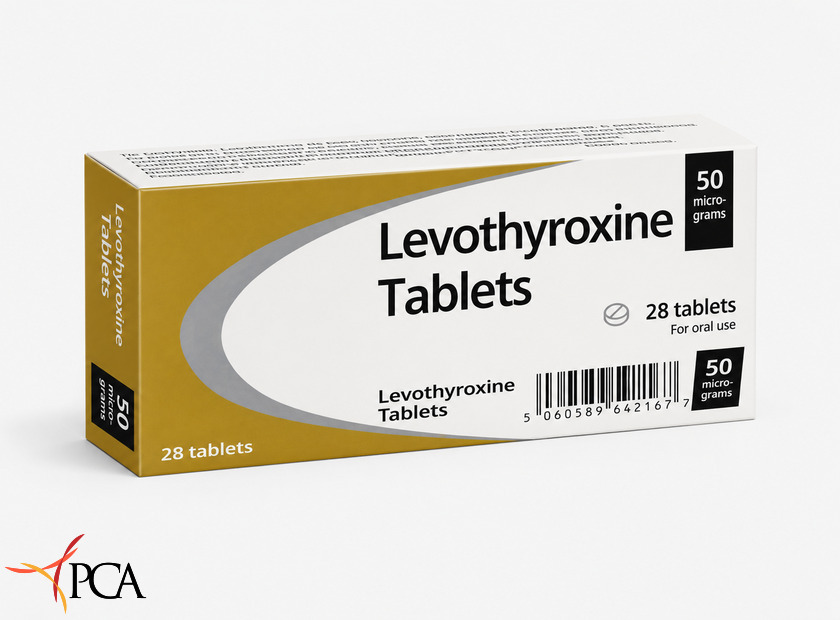
Full replacement runs at roughly 1.6 micrograms per kilogram of body weight each day. That figure applies to an adult with no thyroid function left of their own. For a 70 kg person it lands near 112 mcg. That is exactly why such an odd-looking strength exists on the shelf. The StatPearls monograph gives the same starting arithmetic.
Most people never start at those figures. A gland that still works part-time only needs its shortfall covered. Opening strengths of 25 to 50 mcg are common. Blood work then guides the climb toward whatever that particular thyroid cannot manage.
Age and heart history change the opening move. Past 65, or with known coronary disease, treatment usually begins at 25 mcg. Increases follow in 12.5 to 25 mcg steps every four to six weeks. Thyroid hormone raises the heart’s demand for oxygen, which is the whole reason that climb stays unhurried.
Why Doses Move in 12.5 mcg Steps
Twelve strengths sit between 25 and 200 mcg, spaced more closely than almost any other tablet on a pharmacy shelf. Proportion explains it. Adding 25 mcg to a 50 mcg dose is a fifty percent jump, which lands hard on a person. That same 25 mcg on top of 150 mcg is a gentle adjustment.
Half tablets fill the remaining gaps. Most strengths are scored down the middle, so 12.5 mcg moves are possible without a new prescription. Some patients alternate two strengths on different days to average a figure that no single tablet provides.
Signs the Dose Has Settled Where It Should
TSH is the number that answers this question. Your pituitary pushes it up when thyroid hormone runs low. It eases back down once supply is adequate. That makes TSH a sensitive record of the past several weeks. A result inside the reference range with symptoms quiet is the target everyone is aiming at.
Symptoms trail behind blood levels by a noticeable margin. Energy and mental clarity usually shift first, often within two or three weeks. Cold intolerance and sluggish digestion follow after that. Hair and skin take the longest, sometimes three to six months. They answer to growth cycles rather than to blood chemistry.
Weight moves least of all, which catches people off guard. A few pounds of retained fluid leave during the first weeks. Anything past that follows the same rules it follows for everyone else.
Numbers and symptoms sometimes disagree, and that gap is worth naming. A result inside range with fatigue still present usually points elsewhere. Low iron, low vitamin D, sleep apnoea, and depression all imitate an underactive thyroid. Pushing the strength higher rarely fixes any of them.
The Six-Week TSH Recheck
Blood work belongs six to eight weeks after any change in strength. That interval is not arbitrary. Thyroxine needs roughly five half-lives to reach a new steady level. The pituitary takes longer still to reset its own output. Testing at three weeks produces a number that is still on the move. The American Thyroid Association sets the same window.
Once a result sits where it belongs, the schedule stretches out. Six months is typical for the next check, then once a year after that. Pregnancy, a new medication, or a change of manufacturer resets the clock and pulls the next test forward.
What Quietly Blocks Levothyroxine Absorption
Between seventy and eighty percent of a tablet crosses into the blood on an empty stomach. That share falls the moment anything else is in the way. Uptake happens in the small intestine and needs an acidic stomach ahead of it. Most unexplained TSH results trace back to this section rather than to the prescription itself. Other medicines shift the number too, and metformin is a common one in patients who take both.
Coffee earned itself a study. An Italian group tested eight women whose TSH stayed stubbornly high. Swallowing the tablet with espresso reduced absorption compared with plain water. Waiting sixty minutes erased the effect entirely. Published in Thyroid in 2008, that absorption work is where the sixty-minute rule comes from.
The practical routine is a fixed one rather than a perfect one. Same hour each morning, water only, breakfast afterwards. Bedtime dosing works equally well for people who eat the moment they wake, provided the last meal was three hours earlier.
Consistency beats optimisation every time. A tablet taken with breakfast every single day gives a stable if slightly lower level. A dose adjustment corrects for it. Alternating between an empty stomach one morning and a bowl of cereal the next is what produces results nobody can interpret.
Two medications deserve a separate mention because the gap has to be wider. Bile acid binders and certain cholesterol treatments hold thyroxine in the gut for hours. Anyone taking those needs the schedule set deliberately rather than left to chance.
Side Effects That Point to a Dose Change
Most reported effects are not reactions to the medication at all. They are signals that the amount is running high or low. The hormone matches your own molecule exactly, so there is nothing foreign for the body to object to. Reading these as dose information rather than as side effects is the frame that helps.
Signs of too much
A racing pulse, hand tremor, broken sleep, feeling hot in a cool room, and loose stools.
Signs of too little
Fatigue that never lifted, cold hands, sluggish digestion, dry skin, and a slow pulse.
Long-term over-replacement carries two consequences worth naming plainly. Bone density falls gradually across years. Atrial fibrillation becomes more likely in adults past sixty. Both come from a dose that sat slightly high for a long stretch rather than from any single week.
Hair thinning during the first months puzzles almost everyone it happens to. It usually reflects the low-hormone period that came before treatment rather than the tablet itself. Follicles respond on their own slow schedule, so shedding that began beforehand can run on for a while afterwards.
Genuine allergy is uncommon and traces to a dye or filler rather than the hormone. Moving to another manufacturer usually settles it, and dye-free formulations exist for exactly that situation.
Levothyroxine Questions Patients Ask Most
These five come up once a prescription is already running. Each answer turns on a detail the packaging leaves out.
Is 50 mcg of levothyroxine a high dose?
It sits in the lower half of the range. Full replacement for an average adult falls between 100 and 150 mcg. Half that reads as a starting point. It also serves as maintenance for a thyroid that still does part of the work. Context settles it. A 50 kg woman with residual function may need nothing more. The same tablet leaves a 90 kg patient without a thyroid well short.
Does levothyroxine cause weight gain?
Not on its own. Weight that climbs on a steady strength more often points to under-replacement, since a low level slows the metabolic rate. The common pattern early on is a small loss as retained fluid clears. Anyone gaining steadily has a reason to check TSH rather than to change the tablet.
Is liothyronine the same as levothyroxine?
No. Liothyronine is T3, the active form, while levothyroxine is the T4 reservoir the body converts as it goes. T3 acts within hours and clears within a day, so blood levels swing rather than sit flat. Most patients do well on T4 alone. Combination therapy is reserved for people whose symptoms persist despite normal results.
Can I take levothyroxine at night?
Yes, and some trials show marginally better absorption that way. The condition is an empty stomach, so the last meal should be about three hours behind you. Evening dosing suits people who eat breakfast the moment they wake. Switching times calls for a repeat blood test six weeks later.
Does levothyroxine cause hair loss?
Temporarily, for some people, during the first few months. It reflects the thyroid state the body is coming out of rather than the medication going in. Follicles cycle slowly and are still answering to the low-hormone stretch that preceded treatment. Shedding that begins after a year on a settled strength points somewhere else.
One thread runs through all five. The tablet is a fixed quantity, and everything interesting happens in how a particular body handles it. That is why the blood test outranks the label.
About The Author

Physician credentials verified against the NPI registry, with spoken languages confirmed across US News, WebMD, and Vitals. Pricing reflects rates observed at time of publication.
This information is provided for general educational purposes only and does not constitute medical advice. Always consult a licensed healthcare provider before starting any treatment.
Medical Disclaimer
No page can read your TSH result or know which strength is currently on your prescription. Those two numbers set everything else about this treatment, and nothing written here stands in for them. The person holding both is the one who decides what belongs in your bottle.