
By Dr. Jaffar Khan, MD (Neurology) · Medically reviewed by Dr. Mehrdad S. Toosi, MD (Cardiology)
Buy tizanidine online for muscle spasm that seizes without warning — this short acting relaxer eases spasticity for a few working hours at a time. Those few hours are the design rather than a shortcoming. Multiple sclerosis, a spinal injury, a back locked up after a bad lift — each has its worst stretch of the day.
Tizanidine as a Short Acting Muscle Relaxer
Tizanidine is a muscle relaxer that works in the spinal cord rather than in the muscle itself. A single tablet holds its effect for roughly three to six hours. That narrow window shapes every sensible decision about the medicine. People who buy tizanidine online are usually treating spasm that flares at particular hours, not stiffness that sits there all day.
The mechanism is worth a moment, because it explains the side effects later on. Tizanidine is an alpha-2 adrenergic agonist. It quiets the spinal nerve cells that tell a muscle to keep contracting. Fewer excitatory signals leave the cord, so the muscle lets go.
Those same alpha-2 receptors sit in the circulatory system too. Blood pressure receptors respond to the same chemistry as the spinal ones. Nothing in the tablet can tell the two apart. Drowsiness and a blood pressure dip are not accidents of the formula, then. They come from the same switch that loosens the muscle.
Timings are typical rather than exact. Liver function and other medicines stretch or compress the whole curve.
Prescribers treat that curve as a scheduling tool. The manufacturer says as much in the labelling. Save the medicine for the activities and hours when relief matters most.
How Long Tizanidine Stays in Your System
The half-life is about two and a half hours, so a single tablet has effectively cleared within twelve to fifteen hours. Half the amount is gone by the time you finish lunch. Half of what remains goes in the next stretch, and so on down. Very little is left by the following morning.
Only a fifth to a third of a swallowed tablet ever reaches the bloodstream intact. The liver strips out the rest on the first pass. That detail matters more than it sounds. Anything that slows those liver enzymes sends the surviving fraction upward fast. That is the root of the interaction warnings further down. The StatPearls monograph on tizanidine sets out the same figures.
Standard workplace panels do not screen for it. Nothing in the chemistry reads as an opioid or an amphetamine on a routine test. Carrying the pharmacy label settles the question in the rare case somebody asks.
What Tizanidine Is Used For
The approved use is spasticity, meaning muscles held permanently tight by damage to the nervous system. Multiple sclerosis and spinal cord injury account for most prescriptions. Stroke, traumatic brain injury, and ALS make up much of the rest. Everyday muscle spasm from a wrenched back sits outside that list, though it is prescribed there constantly.
Spasticity and a spasm are not the same complaint. A spasm is a muscle seizing up and then releasing. Spasticity is a muscle that never fully releases. The signal telling it to relax has been interrupted somewhere between brain and limb. The National MS Society page on spasticity describes how that stiffness behaves day to day.
Where tizanidine is normally prescribed
- •Multiple sclerosis — leg stiffness that makes walking heavy and slow
- •Spinal cord injury — tone and jerking below the level of the damage
- •After a stroke — a clenched arm or hand on the affected side
- •Brain injury — raised muscle tone that blocks rehabilitation work
- •Acute back and neck spasm — off label and usually for a week or two
Strength is preserved better here than with several older options, which is why rehabilitation teams reach for it. A leg that has gone loose is no more use than a leg that has gone rigid. Lowering tone without flattening power is the balance being aimed at.
Timing beats dosage in spasticity care. Someone whose legs stiffen worst in the evening does not need coverage at breakfast. Mapping the bad hours before the first tablet saves weeks of guesswork later.
Tizanidine for Back Pain and Neck Spasm
Back and neck spasm are off label uses. They are also the most common reason it gets written in the United States. A wrenched lower back goes into protective spasm, and that spasm becomes its own source of pain. Breaking the cycle for a few days lets normal movement resume.
Short courses are the norm here. Two to seven days covers most acute episodes. Beyond a fortnight the evidence thins considerably, and the sedation stops being a fair trade. Muscle spasm in a healthy back resolves on its own timetable, with or without a tablet.
Night-time dosing suits this group well. Spasm often peaks in the small hours, and drowsiness at eleven at night costs nothing. Daytime doses during a working week are a harder sell. Many people take one at bedtime only and manage the daylight hours with heat and movement. Sleepiness that spills into the day despite that pattern is worth separating from an untreated sleep disorder, which needs its own treatment with a wakefulness medication.
Off Label Use for Sleep and Anxiety
Neither sleep nor anxiety is an approved use, and the sedation is what drives both searches. Drowsiness showed up in about half of the people studied. Turn that unwanted effect on its head and it looks like a sleep aid. That is exactly how people start using it.
The reasoning falls apart on closer inspection. Sedation and sleep architecture are different things. A tablet that makes you drowsy at eleven has worn off by three. The wake-up that follows can be worse than the original problem. Nothing in the medicine addresses why sleep broke down in the first place.
Anxiety has a slightly better rationale, since alpha-2 chemistry does calm the physical side of a stress response. Racing heart and tight shoulders can genuinely ease. The thoughts driving them do not. Treating anxiety this way tends to mask a problem that needs its own plan.
Tizanidine Is Not a Narcotic or Controlled Substance
Tizanidine carries no federal schedule in the United States and it is not a narcotic. It appears nowhere on the DEA list of scheduled substances, which runs from Schedule I through Schedule V. Prescriptions refill like any ordinary one. No monitoring database logs the pickup.
Confusion comes from the company it keeps. Sedating medicines get grouped together in people’s heads regardless of chemistry. Alpha-2 agonists have nothing structurally in common with opioids or benzodiazepines. The receptor is different, the pathway is different, and the reward circuitry that produces craving is simply not involved.
That last row deserves attention, because unscheduled does not mean consequence-free. Stop suddenly after weeks of regular use and the body reacts. Heart rate climbs, blood pressure rebounds above where it started, and muscle tone returns harder than before. Those are the fingerprints of physical adaptation, which is a separate thing from addiction.
Addictive is the word most people reach for, and it does not fit here. Decades of prescribing have produced no recognised pattern of compulsive use. Nobody escalates the strength chasing an effect. Nobody builds a day around the next tablet. What the body does instead is adapt, and the two get confused constantly.
Blood pressure medicines behave the same way and nobody calls them habit forming. Patients who buy tizanidine online after months on it need a taper. A clean break is the wrong exit, and a prescriber sets the steps.
Buy Tizanidine Online After a Video Visit
Ordering runs through an intake form, a video consultation, then pharmacy dispatch. The whole sequence usually finishes inside a day. Patients who buy tizanidine online this way skip the waiting room, not the clinical review. That review is what makes the order legitimate.
Two things get checked before anything is approved. The first is blood pressure, since this medicine lowers it and some people are already running low. The second is the current medicine list, because two common prescriptions rule tizanidine out entirely. Neither check takes long. Skipping them is how a straightforward tablet turns into a fainting episode on a staircase.
Searches for buy tizanidine without prescription lead somewhere worth avoiding. A site that ships without a review has skipped the blood pressure question and the interaction check together. Counterfeit tablets are the other half of that risk. Holding a script already? Send it through our prescription upload page and the order moves straight to the pharmacy team.
Describe the spasm, when it peaks, and which hours of the day you need covered.
A provider reviews blood pressure, liver history, and every medicine you currently take.
The pharmacy ships the tablets with a dosing schedule printed on the label.
Have three details ready before you start. Your most recent blood pressure reading is the first, even a home cuff number will do. Any liver result from the past year is the second. The third is a full medicine list, including anything an eye clinic or a psychiatrist prescribed. The FDA programme BeSafeRx sets out how to tell a licensed pharmacy from a risky one.
Tizanidine Cost and the Zanaflex Brand Name
Cash prices run from $0.80 to $1.71 per tablet, and pack size explains nearly all of that spread. Zanaflex is the original brand name, and tizanidine is the same active ingredient sold under its own label. The tizanidine 2mg price starts at $0.80 a tablet on the largest pack. Buying thirty at a time costs roughly half as much again per tablet.
Strength shifts the arithmetic too. The price of tizanidine 4mg runs from $1.11 to $1.71 per tablet depending on quantity. At most pack sizes two 2 mg tablets cost less than one 4 mg. The 4 mg tablet is also scored for splitting. Worth checking before you settle on a strength.
Count in days rather than tablets when you compare packs. Three doses a day burns through ninety tablets in a month. Someone using one at bedtime only stretches the same pack across three months. Those two buyers should not choose the same quantity.
Brand and generic deserve a straight answer here. Zanaflex carries the original development work, the trials that established the dosing, and decades of manufacturing history behind the name. That history is what you pay for, and it is not nothing. The generic delivers the same tizanidine hydrochloride at a fraction of the cost. Both are legitimate choices with a real trade-off between them.
Insurance rarely changes the picture much. Generic tizanidine already sits among the cheaper prescriptions available, and copays often land close to the cash total. People who buy tizanidine online usually find the comparison takes one phone call to settle.
Physicians Who Review Your Request
Every order is read by a prescriber before the pharmacy fills it. Tizanidine sits across two specialties, so this page draws on both. Neurology answers what the spasticity is doing and which hours need covering. Cardiology watches the blood pressure that the same tablet pulls downward.


Phone: (404) 351-7900 · Online visit: Start a telehealth visit
Sometimes the review ends in a no. Liver disease, a blood pressure that already sits low, and two specific prescriptions each close the door. Saying so plainly is part of the service.
Tizanidine Dosage From 2 mg to 36 mg
Treatment opens at 2 mg and the ceiling is 36 mg across a full day. Doses sit six to eight hours apart, three times in twenty-four hours at most. Increases come in steps of 2 mg to 4 mg per dose, with one to four days between them. Almost nobody needs the top of that range.
The climb is slow for a reason. Blood pressure falls hardest around sixty minutes in, and jumping strengths compounds that. A gradual ladder lets the circulatory system adjust while the muscle effect builds.
Reduced kidney function rewrites the whole table. Clearance slows, levels accumulate, and once daily dosing often replaces the usual pattern. Older patients land in that group more often than they expect. A recent blood test is the only way to know.
Oral contraceptives halve the rate at which the body clears tizanidine. A woman taking the pill can feel a standard dose as though it were double. That interaction is easy to miss, since contraceptives rarely make it onto a medicine list.
Can You Take Two 4 mg Tablets at Once
An 8 mg single dose is within the licensed range, but it is not a step to take on your own. The label allows up to 16 mg in one dose, and the daily ceiling of 36 mg still applies. Reaching for a second tablet because 4 mg felt weak is a different matter entirely.
Blood pressure is the reason for caution rather than the muscle effect. Doubling the amount roughly doubles the drop, and that drop peaks about an hour later. Standing up quickly during that hour is when people go down. A patient already on anything for hypertension stacks two effects on top of each other.
There is also a ceiling on benefit that arrives before the ceiling on dose. Above roughly 8 mg per dose the extra relief flattens out while sedation keeps climbing. Splitting the daily total into three smaller doses beats one large one for most people. Coverage lasts longer and the peaks are gentler.
HCl Tablets in 2 mg and 4 mg Strengths
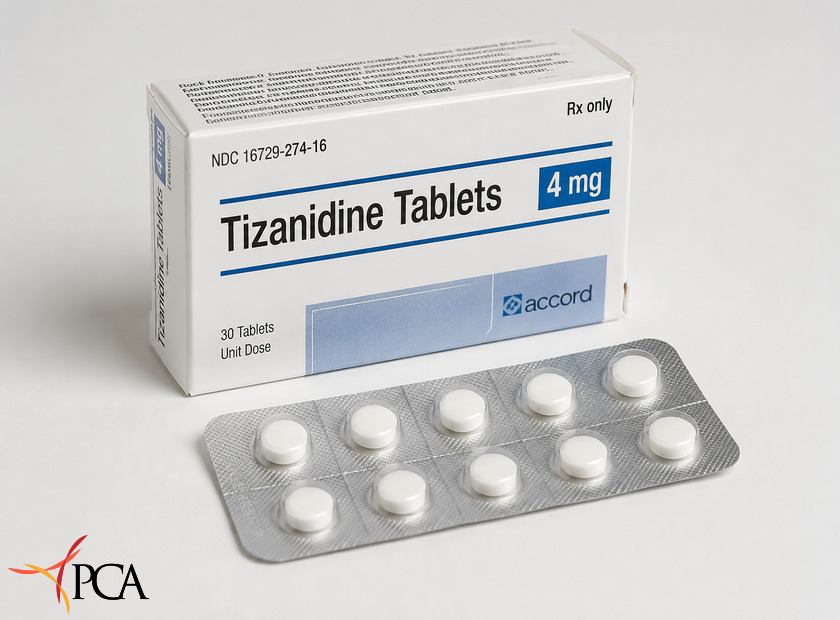
Tizanidine hydrochloride comes as 2 mg and 4 mg tablets, and the 4 mg is scored so it can be quartered. HCl on the box simply names the salt form used to make the tablet. It changes nothing about the effect. The phrase tizanidine buy online turns up mostly 4 mg listings, and that default suits nobody starting out.
Capsules exist as well, in 2 mg, 4 mg and 6 mg. Here comes the detail that catches people out, and it is genuinely unusual among tablets. Capsules and tablets match each other on an empty stomach and stop matching once food is involved.
Food pulls the two forms in opposite directions
Taken with a meal, the tablet delivers a peak roughly 30 percent higher than on an empty stomach. The capsule does the reverse, dropping its peak by about 20 percent. The prescribing information warns that switching between forms, or between fed and fasted, can produce clinically meaningful differences. Pick one form and one routine, then hold both.
This explains a complaint that sounds mysterious otherwise. A patient stable for months suddenly feels flattened by the same strength, or gets nothing at all from it. Nine times out of ten a pharmacy has swapped the form.
The 6 mg capsule has no tablet equivalent, and that is the one genuine reason to prefer capsules. Someone settled on 6 mg three times daily would otherwise juggle a 4 mg and a 2 mg at every dose. Fewer pieces to swallow adds up across a year.
Practical advice follows directly. Choose with food or without, then keep it identical every day. Check the pack on every refill and read whether it says tablet or capsule. A quarter of a scored 4 mg tablet gives a 1 mg step for anyone sensitive to the drop in blood pressure.
Interactions That Rule Tizanidine Out
Two prescriptions make tizanidine off limits outright, and both are common. Ciprofloxacin, an antibiotic, and fluvoxamine, an antidepressant, each block the liver enzyme that clears it. Blocked clearance means the amount in the blood climbs to levels never intended.
The numbers are not subtle. With fluvoxamine on board, exposure to a single tizanidine dose rises thirty-three fold and the peak level twelve fold. Ciprofloxacin produces a ten fold rise in exposure. A cautious 4 mg tablet starts behaving like a dose nobody would ever prescribe, and the blood pressure follows.
Flag these before a first tablet
- •Ciprofloxacin — contraindicated, including a short course for a urinary infection
- •Fluvoxamine — contraindicated, and often prescribed for OCD rather than depression
- •Blood pressure medicines — two lowering effects stack into one dizzy hour
- •Oral contraceptives — clearance roughly halves, so a standard dose lands harder
- •Other sedating medicines — drowsiness adds up faster than either alone suggests
Liver health belongs in this conversation too. Enzyme levels rise in a small share of patients, usually within the first months. The labelling asks for a check at baseline. Another follows a month after the maximum dose is reached. Existing liver disease generally rules the medicine out. Yellowing skin, dark urine, or pain under the right ribs all warrant a same-day call.
Caffeine deserves a brief mention because it uses the same liver enzyme. The effect is minor next to the two contraindicated prescriptions. Someone drinking six coffees a day may still notice the tablet feels different from how it felt on a quiet weekend.
Drinking Alcohol While Taking Tizanidine
Alcohol raises tizanidine levels by about twenty percent and adds its own sedation on top. Two separate problems arrive together. One is chemical, since alcohol slows the same liver machinery. The other is simple addition, because both flatten alertness and both lower blood pressure.
Timing softens the problem without solving it. Several hours between the drink and the tablet reduces the overlap. Complete separation on dosing days remains the safer pattern. That goes double for the first fortnight, while your own response is still unknown.
Tizanidine Side Effects Worth Watching
Dry mouth and drowsiness lead the list, each reported by roughly half of patients in the original trials. Weakness follows close behind at about four in ten. Dizziness affects around one in six. Those four account for nearly every complaint that reaches a prescriber.
Most of them ease over the first two weeks as the body adapts. The table below sets out how often each turns up and what usually happens next.
Hallucinations sit at the bottom of that table and deserve more than a footnote. Vivid images or voices, usually while falling asleep or waking, were reported by around three in a hundred trial participants. People rarely mention it, either from embarrassment or from assuming it was a dream. Patient information from MedlinePlus on tizanidine lists the same effect in plain language.
Get help without waiting
Fainting, a pulse that feels unusually slow, yellowing of the skin or eyes, dark urine, seeing or hearing things that are not there, or a rash with facial swelling all need urgent attention rather than a wait-and-see week.
This medicine is a tool for specific hours, not a background prescription that runs quietly for years. Patients who buy tizanidine online and treat it that way get the most out of it. A tablet timed for the afternoon that actually matters beats three taken out of habit.
About The Author

Medical Disclaimer
This page is general education and nothing more. It cannot see your blood pressure, your liver results, or the other prescriptions in your cabinet. A licensed provider who knows all three is the only person able to judge whether this treatment suits you. Speak with one before starting, changing, or stopping anything described above.